










How to Use AI Authentically When Your First Reaction Is “Ew, No”
The Question I Could Not Wait to Ask Kinsey
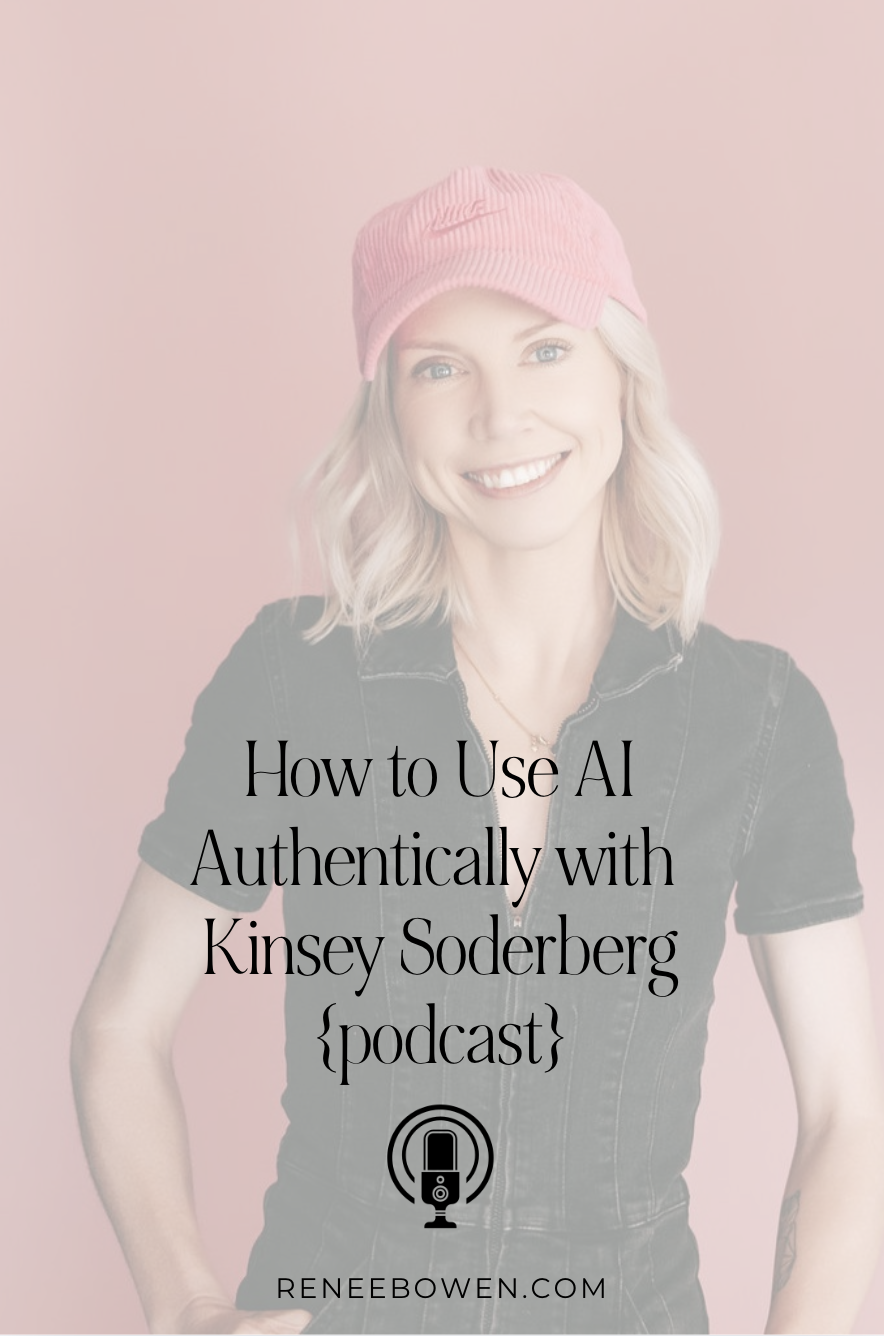
Figuring out how to use AI authentically has become one of the most common conversations I have with creative entrepreneurs, and most of them come to it carrying a very specific fear. They worry that the more they lean on these tools, the more their captions and emails will sound like everyone else’s (which, if you have scrolled Instagram lately, is a pretty reasonable worry). So when I sat down with Kinsey Soderberg of Authentic AI, co-founder of Her AI Era and Her AI Club, I went straight to the heart of it. I asked her whether AI can help us become more ourselves or whether we are all at risk of using it to become more like everybody else. Her answer was refreshingly practical.
AI Is Neutral, Which Puts the Choice Back in Your Hands
Kinsey describes AI as neutral, much like the internet, which can be awesome and a little scary depending on how people use it. Because the tools can take on personalities, we forget that and treat AI like a being with opinions. That reflection is part of the magic, because a good conversation with Claude or ChatGPT can help you hear your own thinking more clearly. It is also the risk, because AI is very much a hype woman, as Kinsey put it, and it will happily cheer for a mediocre idea if you stop using your critical thinking. The people who learn how to use AI authentically treat it as a creative collaborator and keep their brains switched on, while the people who hand over the thinking end up with the same generic output everyone else is posting. Kinsey jokingly called that second path the road to an Idiocracy future, and honestly, she is not wrong.

The Grumpy Curmudgeon Moment That Started Everything
What I love about Kinsey’s story is that she did not start out as an AI cheerleader at all. She first heard about ChatGPT at a podcasting conference, and her gut reaction was a hard pass, because she did not want a robot writing her emails and she worried about what these tools would do to our creativity. A few months later she was on a two-hour solo drive through a canyon when the woman on the podcast she was listening to started talking about AI, and that familiar grumpy feeling showed up in her body. This time she recognized it as the same feeling she got every time something new in business asked her to change, and she realized the grumpiness was fear. She decided getting curious would serve her better than becoming a grumpy curmudgeon. She emailed her whole audience, invited them to get curious with her, and that is how Authentic AI was born, with everyone already along for the ride.
Why So Much AI Design Looks the Same (and How Kinsey Avoids It)
One of the reasons I adore Kinsey is that her vibe-coded pages always look gorgeous, and they look like her. She was the design editor of her high school yearbook, so she has always had an eye, but her process works for people who would never call themselves designers. She starts with Pinterest screenshots of things she loves, gets specific about what she loves in each one (the colors, the angles, the shadows, the layout), and then briefs Claude the way a creative director would brief a designer. Most people accept the first thing the tool hands them and never critique it, which is exactly why so many AI-built websites look like cousins. My husband Andrew sees the same thing with his film pitch decks, because the tool gets incredible the second he feeds it actual images. If you want to know how to use AI authentically in your visuals, start with your own taste and let the tool follow it.
Where Inspiration Ends and Theft Begins
Feeding AI screenshots of work you love raises the question every photographer I know is already asking, which is where inspiration ends and stealing begins. Kinsey pointed to Elizabeth Gilbert’s Big Magic and the idea that ideas move around the world looking for a home, which is why two people across the planet can invent the same thing at the same time. She believes in protecting specific IP, like an artist’s exact piece of work, and she also believes taking inspiration from each other is what creativity has always been about. As a photographer, I will add that people were stealing our images long before AI showed up, and none of us creates in a vacuum. Holding your boundaries and staying generous can both be true, and that balance is a big part of how to use AI authentically without becoming the grumpy curmudgeon Kinsey refused to be.
Where to Start Tomorrow Morning
Kinsey’s first step is beautifully simple, which is to open Claude or ChatGPT and introduce yourself in a brand new chat. Talk to it the way you would talk to a friend, using voice mode or a dictation app like Wispr Flow, and ramble about what bothered you this week or the business problem you cannot stop thinking about. The tool organizes all of that mess, and because memory has improved so much, it keeps learning you over time. From there you can add your Human Design or a screenshot of your birth chart, which I did on day one with ChatGPT because I have a slight problem with personality tests.
That is how to use AI authentically in its simplest form, and if you want to see where it goes from there, come hang out at the Her AI Era Summit, where I am teaching how to use AI to excavate your five-year vision.
FAQ
How to use AI authentically without sounding like everyone else?
Start by giving the tool real information about you, including how you talk, what you believe and examples of work you love. Then push back on the first draft instead of accepting it, because the first output is where generic lives. Kinsey Soderberg recommends thinking like a creative director and telling the AI specifically what you like and why.
Can AI help me become more like myself?
It can, depending on how you use it. When you treat AI as a thinking partner that reflects your ideas back to you, it can help you see your own patterns and trust your decisions more. The risk shows up when you let it do your thinking for you, so keep your critical thinking switched on.
What is vibe coding?
Vibe coding means building a website, dashboard or online tool by describing what you want to an AI tool in plain language, with no need to know HTML, CSS or JavaScript. Kinsey uses Claude for most of her vibe coding, and tools like Lovable work too. Her AI Club members have built things like a focus dashboard with a Pomodoro timer and a confetti celebration when the timer goes off.
How do I make an AI-designed website look less generic?
Begin with visual inspiration, like Pinterest screenshots or a website you already love, and tell the AI exactly which elements you like. Then critique the first version and ask for changes instead of accepting it as is. Your taste is the ingredient that keeps the design looking like you.
Is using inspiration images with AI the same as stealing?
Kinsey draws a clear line between protecting specific intellectual property, like an artist’s exact piece of work, and taking general inspiration, which creatives have always done. Copying someone’s exact work is a problem with or without AI. Using what you love as a starting point and building your own version is how creativity has always worked.
Should I give AI my Human Design or astrology chart?
If those frameworks feel meaningful to you, sharing them can help your AI tailor how it works with you, like pulling you back to focus when you chase too many ideas. Kinsey and her co-founder Joyce Hamilton had Claude analyze both of their personalities, and I gave ChatGPT my full chart and personality profiles very early on. Treat it as one more layer of context about how you work best.
Watch on YouTube
LINKS:
Her AI Era Summit
Her AI Club on Instagram
Kinsey on Instagram











Read the Comments +